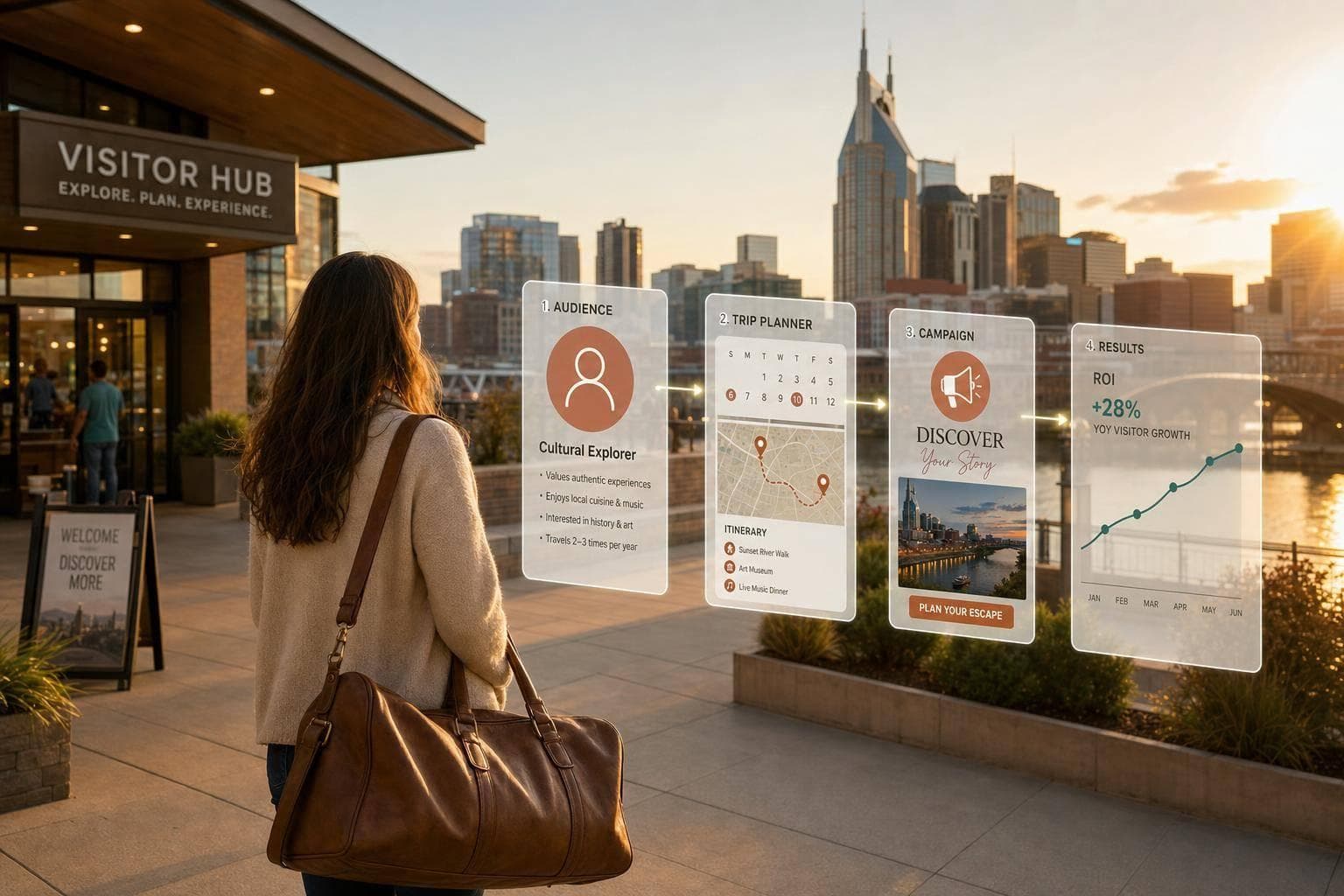
The Ultimate Guide to Destination Marketing for CVBs
A CVB is not selling one thing. I’m helping people choose a place. That means I need different messages for leisure travelers, meeting planners, tour groups, and event visitors - then I need to guide each one toward a clear next step, like a guide download, partner click, RFP, or hotel booking. The article’s main point is simple: brand alone is not enough. CVBs need content and campaigns that lead to visits and local spending.
Here’s the short version:
- Start with audience segments and goals. Leisure, meetings, groups, and event visitors all plan trips in different ways.
- Keep one brand promise. Then shift the message by audience, season, and trip type.
- Build planning tools people will use. Print, digital, and relocation guides, maps, itineraries, event pages, and kiosks all help move people from interest to action.
- Send campaign traffic to the right pages. Social, email, paid search, LinkedIn, and co-op campaigns should point to landing pages, guides, and booking paths.
- Track visits, referrals, room nights, and inquiries. Impressions alone do not show impact.
- Use data to update content. If one itinerary or partner listing gets more clicks, I should feature it more.
A few numbers stand out fast:
- $1 in destination marketing can return $38 in visitor spending.
- 88% of DMOs put budget into social ads.
- 97% use Instagram and 90% use Facebook.
- Drive markets within about 3 hours often convert better and cost less than faraway markets.
- About 80% of DMOs run co-op campaigns.
If I had to boil the whole piece down to one sentence, it would be this: a CVB wins when it makes trip planning easy, gives each audience the right path, and ties marketing work back to local economic results.
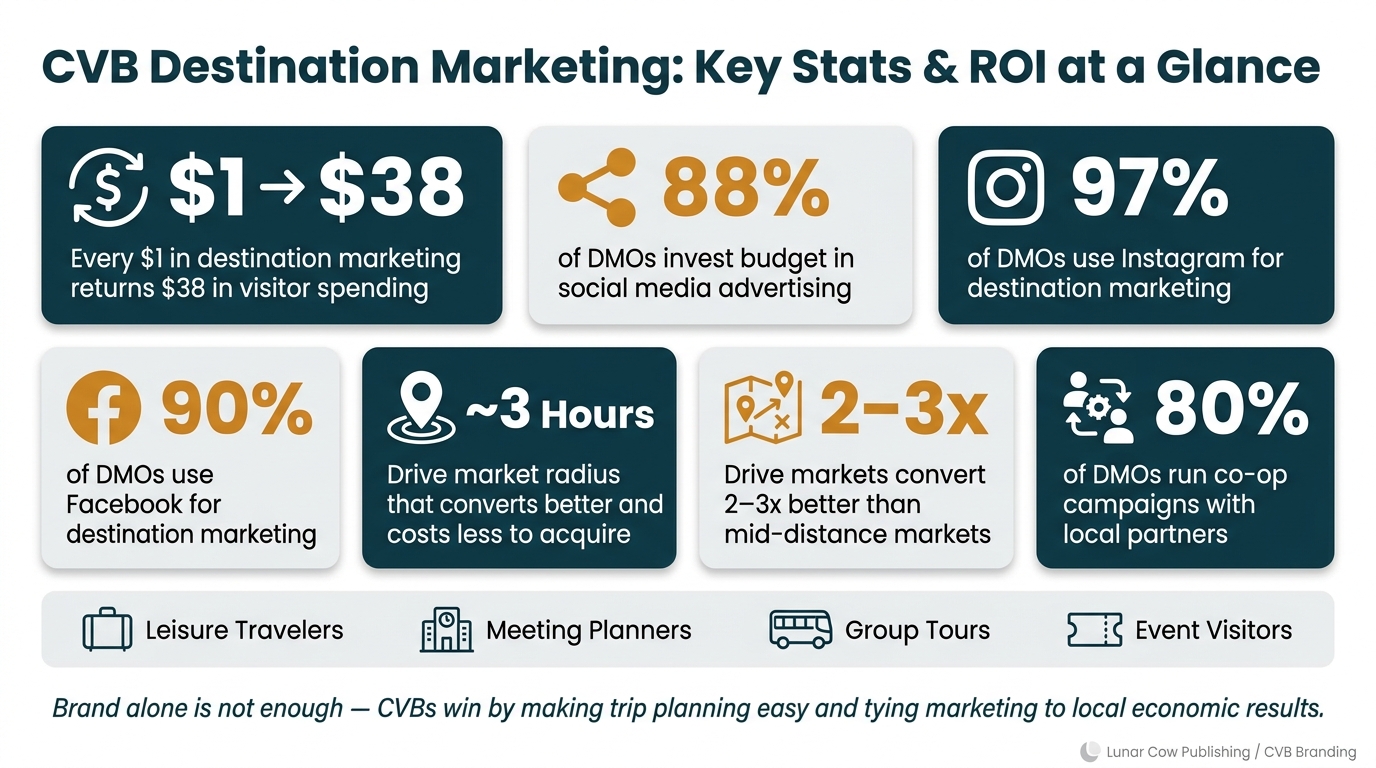
CVB Destination Marketing: Key Stats & ROI at a Glance
EPISODE 92: Top 10 Destination Marketing Strategies
sbb-itb-909066b
Build the Foundation of a CVB Destination Marketing Plan
Before a CVB runs campaigns or publishes travel guides, it needs a clear plan. Start with the basics: who you're trying to reach, why they should pick your destination, and what action you want them to take. Skip that groundwork, and even a big budget can fall flat. Get it right, and that plan becomes the backbone for your content, tools, and campaigns.
Define Audience Segments and Marketing Goals
Most CVBs need to plan around four main audiences. Each one shows up with different motives, needs different content, and responds to different calls to action.
Leisure travelers want culture, local flavor, and simple trip ideas. Meeting planners care about safety, venue capacity, access, tech, and sustainability. Group tour operators need smooth logistics and experiences that feel worth the trip. Event visitors are focused on one thing: getting the details they need for a specific event.
Here’s how those needs usually break down:
| Audience | Primary Motivations | Planning Window | Key CVB Content Needs | Best Conversion Action |
|---|---|---|---|---|
| Leisure Travelers | Attractions, culture, local character, and emotional appeal | 3–4 months out | Neighborhood guides, thematic itineraries, hidden gems | Outbound click to partner; newsletter signup |
| Meeting Planners | Safety, infrastructure, tech, and sustainability | 6–12+ months | Venue specs, capacity charts, accessibility info | RFP submission; site visit inquiry |
| Group Tours | Unique experiences, ease of logistics, and "only here" gems | Long-term | Motorcoach parking info, group itineraries, partner spotlights | Direct inquiry; itinerary download |
| Event Visitors | Specific festivals, sports tournaments, or concerts | Event-specific | Event calendars, practical planning, transport and parking info | Ticket purchase; hotel room night booking |
Nearby drive markets - usually within about three hours - tend to convert better and cost less to acquire than faraway markets. That’s why goals should focus on conversion and ROI, not just impressions. In practice, that means tracking things like partner referrals, RFP submissions, and room night bookings.
All of those audience differences should still point back to one brand promise. You’re not building four separate destination identities.
Set Brand Positioning and Message Structure
A destination brand is the clear reason someone should choose your place over another one. And because a CVB is marketing a place - not a single product - that reason needs to hold up across every channel and every audience. From there, the job is to turn that promise into messages that fit each audience.
"If your destination feels like it could be swapped out with any other on the list, you're not going to stay top of mind." - Mansi Soni, Content Production Lead, Cvent
Strong CVB positioning starts with four building blocks:
- Core identity
- Key differentiators
- Primary audiences
- Seasonal spread
From there, you can shape one master brand promise that works across every channel and every audience.
The hard part isn't writing the promise. It's keeping the voice steady while changing the message for people with very different needs. The fix is simple: use one master brand promise, then adjust the details by audience. Leisure campaigns can lead with culture and character. Convention sales can lead with venues and logistics.
Build the Core Content and Visitor Tools CVBs Need
Once your audience segments and positioning are in place, the next move is building the content and tools that turn interest into actual visits. That includes print guides, digital guides, interactive maps, website content, and on-site kiosks. Each one supports a different point in the visitor journey.
Visitor Guides, Community Maps, and Advertising-Supported Publishing
A well-made visitor guide is still one of the most important assets a CVB can have. It brings lodging, dining, attractions, shopping, and events into one place. And when the guide is ad-supported, it also gives partner businesses useful exposure through listings and ad placements.
Feature named restaurants, attractions, and neighborhoods with clear wayfinding and QR codes that connect print to digital. Lunar Cow Publishing can handle the editorial, design, printing, and ad sales workflow for custom visitor, community, and relocation guides.
That print-to-digital path should carry through every visitor touchpoint.
Mobile Digital Guides, Interactive Maps, and Kiosks
For planners who begin online or need help while they’re already in-market, digital tools extend the guide’s reach.
Lunar Cow Publishing offers several tools built for that job. GoGuide is a mobile-friendly digital guide that lives on your site, with auto-updating features and a full analytics package. iMap 3.0 adds interactive mapping, itinerary building with turn-by-turn directions, and clickable attractions. For visitor centers, airports, and convention spaces, Kiosk brings the same functions to a standalone unit with touchscreen wayfinding, printing, and on-site support.
Mobile digital guides can also include Book Now buttons, embedded video, and live links to menus or booking pages. That helps drive clicks, bookings, and referrals.
Here’s how each tool fits into the CVB toolkit:
| Tool | Primary Audience | Use Case | Key Features | Partner/Revenue Role |
|---|---|---|---|---|
| Print Visitor Guide | High-value guests, on-site visitors | Arrival orientation | High-quality imagery, QR codes to digital | Ad-supported publishing, brand awareness |
| GoGuide | Mobile users, early-stage planners | Digital guide access on any device | Responsive design, auto-updates, analytics | Direct referral tracking, lead generation |
| iMap 3.0 | Active explorers, trip planners | Interactive mapping and itinerary building | Clickable attractions, turn-by-turn directions, trip builder | Regional dispersal, partner spotlights |
| Kiosk | Travelers at airports, visitor centers | Quick on-site access and wayfinding | Touchscreen wayfinding, printing, on-site support | High-visibility ad placements, on-site support |
| Website Itineraries | Early-stage planners | Themed trip structuring | Themed routes, transport tips, meal suggestions | Multi-partner routing, SEO authority |
Each asset should move visitors to the next step, from discovery to itinerary to booking. Digital guides can also track engagement heatmaps and outbound clicks, so you can see which partners are getting referrals and which content is driving action.
Those same planning habits should show up on the website too, because that’s where most trip research starts.
Website Content, Event Calendars, and Itinerary Planning
Your CVB website should act as the destination’s trip-planning hub, not just a homepage with a contact form. It should answer trip questions fast and guide visitors to partner listings, itineraries, and booking actions.
Core CVB site sections include:
- Things to Do
- Places to Stay
- Restaurants
- Events
- Meetings & Conventions
- Group Travel
Each section needs to do real work. A destination hub page about things to do should be substantial and activity-rich if it wants a realistic shot at ranking in search results. Event calendars should be updated 3 to 4 months before each season so you can catch early search demand.
Themed itineraries also help a lot. A 2-day, 3-day, or 5-day route built around food, history, or family activities gives planners something concrete to use. It also guides visitors across multiple partner locations, which makes the destination easier to pitch to groups.
Add practical planning pages for transportation, weather, accessibility, and safety tips so confirmed travelers can lock in trip details. A Things to Do page should link to a related itinerary. That itinerary should link to a map. The map should link to partner listings. The point is simple: move visitors from browsing to booking.
Run Coordinated Campaigns That Drive Visitation
Use campaigns to send people into the guides, maps, itineraries, and booking links you already built. That’s the job here: move audiences into the CVB assets that turn interest into actual visits.
Social Media and Email Campaigns by Audience Segment
Social media and email do different things. Social sparks interest. Email gets people to act.
On social, start with strong visuals and story-led content. Instagram and Facebook are still the main channels for destination campaigns. Globally, 88% of DMOs put money into social ads, with Instagram usage at 97% and Facebook at 90%. The goal isn’t just likes. It’s action.
Use short-form video to drive saves, clicks, and guide downloads. Focus on trip ideas people can picture right away: weekend getaways, hidden gems, food trails, seasonal trips, and family itineraries. For meeting planners, show off-site activities attendees can do before or after an event. That gives planners something they can take back to internal stakeholders. For group tours, travel-trade training and sample itineraries can help turn agents into active sales channels. For event visitors, seasonal guides and event-specific landing pages lined up with search demand make planning simpler.
That same audience approach should carry over to email. Segment by audience and send content that fits each stage of trip planning. Promote seasonal events, link straight to itinerary pages, and use guide downloads as a clear CTA. It gives people an easy next step instead of leaving them to hunt around the site.
Paid Media, Co-op Campaigns, and Partner Promotion Models
Paid media helps you reach people organic content won’t. A smart place to start is seasonal campaigns in drive markets, usually within a 3-hour radius. These markets tend to convert 2 to 3 times better than mid-distance markets.
For meeting planners, LinkedIn ads can work well when the CTA is direct, like "Submit RFP" or "View Venue Specs." And once someone clicks, send them to a dedicated landing page, not a general homepage. VisitPITTSBURGH did this with a "Plan Your Trip" landing page built with several distinct calls to action for paid traffic. That’s the point of paid media in this setup: distribute CVB content. Guides, itineraries, venue pages, and landing pages do the conversion work.
Co-op campaigns are another way to make media dollars go further. About 80% of DMOs run co-op campaigns to reach more people and increase total marketing spend. Hotels, attractions, restaurants, and venues pay into shared placements across digital products, visitor guides, and maps. The CVB drives demand. Partners bring the bookable offer and split the cost. These campaigns tend to work best when they send traffic back to the same landing pages and use the same tracking setup.
| Channel | Primary Objective | Key Call to Action |
|---|---|---|
| Paid Search | Capture high-intent planners | "Download Visitor Guide" / "View Itinerary" |
| Social Media | Inspiration and engagement | "Save to Trip Planner" / "Watch Video" |
| Email Marketing | Nurturing and retention | "Book Seasonal Package" / "Explore Map" |
| LinkedIn Ads | Meeting planner outreach | "Submit RFP" / "View Venue Specs" |
| Co-op Campaigns | Partner visibility | "View Offer" / "Claim Offer" |
Measure Results and Improve the Program Over Time
Track Channel Metrics That Connect to Visitation
Once campaigns are live, reporting tells you two things fast: which assets are driving visits, and which ones need to be cut, fixed, or rebuilt.
For a CVB, reporting should connect campaigns to room nights, visitor spending, group inquiries, and partner referrals - not just impressions. It also helps to break results out by audience, so leisure, meeting, group, and event campaigns can all be judged against the same business outcomes.
Here’s a simple view of the metrics that matter most for CVB stakeholders:
| Channel or Asset | Primary KPI | Secondary KPIs | Audience Served | Likely Business Outcome |
|---|---|---|---|---|
| Website | Organic landings and partner clicks | Session duration, bounce rate, search demand growth | Active planners | More guide downloads and referral traffic |
| Digital Guides | Downloads / Views | Page depth, time spent, save rate | High-intent travelers | Lead generation for local partners |
| Interactive Maps | Map Interactions / Clicks | Geotag engagement, foot traffic data | In-destination visitors | Visitor dispersal and increased local spend |
| Click-Through Rate (CTR) | Clicks to itinerary or booking pages, conversion from partner links | Opt-in prospects | Repeat visitation and seasonal bookings | |
| Social Media | Link clicks / landing-page conversions | Video views, shares, UGC tags | Inspiration seekers | Demand generation for site traffic and guide downloads |
| Partner/Trade | Referral Clicks to Partner Sites | RFP submissions, venue site visits, agent training completion | Meeting planners / Trade | Direct economic impact and room nights |
| Paid Media | Conversion Rate / ROI | Cost per acquisition (CPA), flight and hotel bookings | Targeted segments | Immediate visitation and revenue growth |
The path from inspiration to an actual visit can stretch across months. That’s why multi-touch and survey-based attribution matter so much; last-click reporting alone tends to understate CVB impact.
Use Reporting Cycles to Update Guides, Maps, and Campaigns
A tiered reporting rhythm helps keep a CVB on track at every level.
- Monthly reports focus on tactical shifts like web traffic, email clicks, and social engagement.
- Quarterly reviews focus on stakeholder alignment around leads, partner participation, and guide performance.
- Annual reports make the economic case through ROI, estimated room nights influenced, and total visitor spending impact.
Quarterly reviews are also where content decisions get a lot easier. Data from digital guides, interactive maps, and website behavior shows which itineraries get saved, which map points get clicked, and which partner listings send referral traffic.
That kind of detail matters. If one itinerary keeps beating the others, that’s a clear sign to expand it, feature it earlier, and give it stronger placement in the next guide edition. If a partner listing gets little to no click activity, it may need a content update or a better spot in the map hierarchy.
Tools like Lunar Cow Publishing's GoGuide and iMap 3.0 can support this review process with analytics, trip-planning behavior, and map engagement data. In plain English, they help teams update content and fine-tune partner packages with less guesswork.
Those findings connect audience strategy, content, and campaign spend into one system.
Conclusion: The CVB Destination Marketing System
Effective destination marketing for a CVB isn’t one campaign or one publication. It’s a connected system.
You start by defining who you want to reach and what your destination stands for. Then you build the tools visitors actually use - guides, maps, itineraries, event calendars, and trip planners. After that, you run campaigns that move people into those tools. Then you measure the results so the next cycle performs better.
The CVBs that keep strong programs going over time tend to invest in year-round visitor tools, build partner co-op promotion models that share costs and extend reach, and track ROI reporting that ties marketing spend to local economic impact. That mix - audience strategy, visitor tools, campaigns, and reporting - is what turns a destination marketing budget into a demonstrable return for the community it serves.
FAQs
How do I choose the right audience to target first?
Start by looking at the visitors you already get. Find out who’s traveling to your destination now, which groups come back most often, and where they’re coming from. That gives you a solid starting point based on what’s already working.
Then dig into the research. Look for market segments, event trends, and unmet demand that line up with your destination’s strengths and the infrastructure you have in place. The goal is simple: match the right audience to what your destination can actually deliver.
Keep your attention on nearby source markets within a three-hour drive or flight. From there, break audiences into interest-based groups, like experience-seekers or value-conscious travelers. That kind of segmentation makes your marketing far more specific.
It also helps to look at visitor needs beyond price or location. Can your destination support demand around sustainability, accessibility, or new tech? If the answer is yes, those areas may help you stand out and attract the right travelers.
What should a CVB track besides impressions?
Beyond impressions, CVBs should track metrics that show conversion and economic impact. That means looking past surface-level reach and focusing on what leads to bookings, referrals, and spending.
Key measures include:
- Booking conversions
- Direct referrals
- Total economic impact
For group and event business, the picture gets a bit broader. CVBs should also track attendance growth, repeat bookings, delegate spending, delegate satisfaction, and visitor data like travel patterns, market segments, and the attractions driving visitation.
How can a visitor guide drive more bookings?
A visitor guide can drive bookings when it works like an interactive marketing tool, not just a static brochure. In a digital-first format, CVBs can add Book Now buttons that send travelers straight to hotel partners or booking engines, which cuts friction from the planning process.
It can also influence travel decisions by giving people trusted information, live links to menus or tickets, and ideas that spark new trips or longer stays.