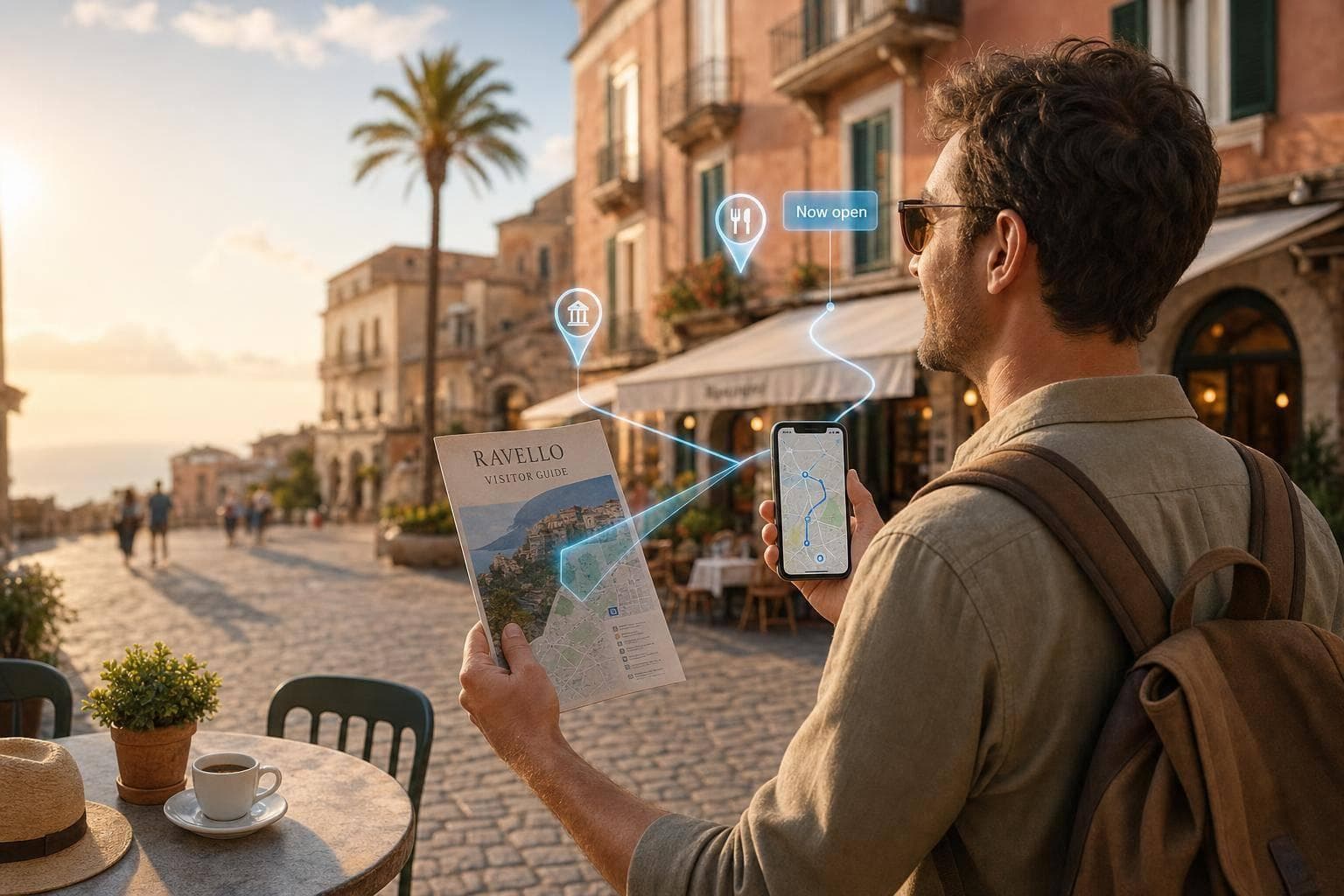
Print vs. Digital Visitor Guides: Which Works Better?
If I need one short answer, it’s this: print helps with trust and trip ideas, digital helps with updates, navigation, and tracking, and most DMOs do best with both.
I’d look at this choice by job, not by format alone. Print can drive spending - about $48 per copy - and printed maps remain one of the most-used guide pieces. But 80% of travelers plan trips online, which makes digital hard to ignore. So the best pick depends on what you need most: inspiration, wayfinding, sponsor exposure, lead collection, or reporting.
Here’s the simple breakdown:
- Print guides work well for pre-trip interest, in-room browsing, and ad visibility that stays in front of visitors.
- Printed maps help with on-the-go use and are often the most-used print item.
- PDFs are easy to send, but they can be hard to use on phones.
- Flipbooks look polished, but mobile use can be weak.
- Mobile web guides are easier to search, update, and use on smartphones.
- Map and trip tools help visitors route stops, find places, and use live directions.
- Hybrid setups connect print to digital with QR codes, which helps with both reach and reporting.
What matters most in this comparison? The article weighs each format on:
- Reach
- Ease of use
- Update speed
- Cost
- Ad value
- ROI
Quick Comparison
| Format | Best for | Main upside | Main downside |
|---|---|---|---|
| Print guide | Trip ideas, trust, sponsor exposure | Stays with the visitor | Hard to update |
| Printed map | Wayfinding, local discovery | Simple in-market use | Static info |
| Email delivery, offline file | Easy to share | Weak phone experience | |
| Flipbook | Visual browsing | Good brand presentation | Often clunky on mobile |
| Mobile web guide | Search, mobile planning, live info | Easy to update and track | Needs steady upkeep |
| Map/trip tool | In-market navigation | Directions and itinerary help | May depend on signal |
| Hybrid | Full visitor journey | Print + digital together | Takes coordination |
If I were making the call, I’d keep it simple: use print for stable content, digital for fast-changing content, and hybrid when I want both reach and data.
sbb-itb-909066b
How Visitor Guides Support Tourism and Community Marketing
Visitor guides help turn interest into actual spending. You can see that most clearly in three places: when people are deciding where to go, when they’re already in town, and when you need hard numbers for partners and sponsors.
Trip Inspiration and Pre-Arrival Planning
Print gives people a high-trust touchpoint before they arrive. There’s something about holding a guide in your hands that makes a place feel more concrete. That matters because about 85% of undecided travelers say a visitor guide influenced their choice to visit a destination, and 60% picked a specific attraction or activity directly because of guide content.
Digital guides play a different role. They fit how people plan now: searching, comparing options, and building out an itinerary. With 80% of travelers preferring to plan vacations entirely online, your digital guide needs to be part of that path through search, email, or social media.
Once visitors arrive, the guide stops doing as much selling and starts helping them get around.
In-Market Navigation, Local Discovery, and Business Exposure
Printed guides and maps tend to stick around during the trip. They sit in hotel rooms, on passenger seats, and in tote bags. That steady visibility can shape spur-of-the-moment decisions. In fact, 91% of brochure users say print materials influenced them to visit a place they hadn’t planned to see. That kind of spontaneous discovery is tough to match on a screen.
Mobile-friendly guides and interactive maps solve a different problem. They help with real-time navigation, updated details, and direct booking links. They can also push traffic beyond the biggest attractions by using itineraries that connect anchor attractions with smaller local businesses. For chambers and CVBs, that can help spread visitor spending across the region instead of concentrating it in just a few spots.
A guide listing or map pin can put a small business in front of visitors right alongside major attractions.
That same setup also helps with sponsor exposure and lead capture.
Lead Generation, Advertiser Visibility, and Measurable Outcomes
Guide requests and downloads are standard performance metrics. A print guide request can collect a mailing address. A digital guide download can collect an email address.
Digital formats give you more detail on performance. Interactive flipbooks and mobile guides can show engagement heatmaps and click-through rates. That means you can tell a local restaurant sponsor exactly how many users clicked on its listing. Print is measured in other ways, such as distribution totals, guide request volume, and survey feedback. Both have a place, but they answer different questions for partners.
QR codes can link print-driven interest to updated digital content.
Print Visitor Guides: Where They Still Perform Best
Print does its best work when trust, staying power, and sponsor exposure matter most.
Why Print Works for Planning, Credibility, and Sponsor Value
Print still has a level of trust that’s hard to beat, especially for people relocating, road trippers, and seasonal visitors who like to plan with something they can hold. A printed guide doesn’t disappear with a swipe. It stays with visitors through the trip, which gives it more time to do its job.
It also sticks around longer. Guides end up in car door pockets, hotel lobbies, and on nightstands. They get passed from one person to the next too. In fact, 95% of brochure users share them with others, reaching an average of 2.4 additional people per guide. That kind of repeat visibility is tough for digital to match. For advertisers, that means their message keeps showing up across the full trip, not just for a few seconds.
Print also gives destinations space to tell a fuller story instead of cramming everything into short listings. Destination Madison showed this in 2024, when it printed 100,000 copies of a redesigned, evergreen visitor guide and moved to a marketing-led branding approach that put steady storytelling ahead of a purely ad-funded model.
Where Print Falls Short: Lead Times, Updates, Storage, and Distribution
The biggest downside is speed. Print moves slowly. Content is often locked months before distribution, so hours, event dates, and other time-sensitive details can be out of date before the guide even reaches the visitor. That creates problems for advertisers and can chip away at trust in the organization.
Distribution brings its own set of costs and headaches. Guides have to be stored, shipped, and placed in hotels, visitor centers, and mail fulfillment programs. That takes warehouse space and tight coordination. On top of that, some hotels now limit in-room printed materials, which cuts down on placement options. And with paper costs rising as much as 25% due to tariffs on imports, large print runs are tougher to defend unless ad revenue is strong or the ROI case is clear.
How to Measure Print Results and Justify the Budget
Print is harder to track than digital, but it’s not a black box. You can still measure it in a clean, useful way. The main KPIs for chambers and CVBs include:
- Guide requests
- Fulfillment totals
- Visitor center pickup counts
- QR code scans tied to specific distribution points
- Trackable calls linked to print placements
These numbers help with sponsor reporting and give ad sales teams something concrete to point to. They also help answer the big budget question: is print pulling its weight? In many cases, yes. Official DMO visitor guides can generate about $48 in visitor spending per copy distributed.
That matters most when teams are weighing print against digital channels that are faster and easier to measure.
Digital Visitor Guides: More Flexibility and Better Data
Digital Formats That Fit Destination Marketing Workflows
Print has staying power. Digital has speed, search visibility, and data you can actually use.
For pre-arrival planning, responsive web-based guides are the strongest fit. They’re searchable, mobile-friendly, and easier for search engines and AI tools to read. When that content is structured well and includes the right keywords, destinations have a better shot at showing up in search results and AI-driven recommendations. As Erin White, Director of Strategic Development at Envisionit, put it:
"Your destination's next visitor isn't flipping through a physical guide - they're asking AI for recommendations. If your content isn't in that conversation, another destination's will be."
Digital is at its best when the goal is fast updates, wayfinding, and sponsor tracking you can measure.
Interactive flipbooks still have a place for visual storytelling, but they tend to struggle on phones. Downloadable PDFs work better as backup files or email assets than as the main planning tool. Once visitors are on the ground, digital tools can do far more than static pages ever could.
That’s where map-based and trip planning tools come in. Lunar Cow Publishing’s iMap 3.0 and GoGuide are built for in-market use. iMap 3.0 includes turn-by-turn navigation, itinerary building, points of interest, trails, and a calendar of events, all hosted right on your organization’s website. GoGuide offers a mobile-friendly guide with responsive design, auto-updating features, and full analytics.
Each format does a different job. Some are best for planning. Some help people get around. Some are better for tracking engagement. The best pick depends on the visitor task in front of you.
| Digital Format | Best Use Case | Key Strength | Primary Limitation |
|---|---|---|---|
| Responsive Web Guide | Pre-arrival planning & SEO | Easy for search and AI tools to parse, real-time updates | Requires ongoing maintenance |
| Interactive Flipbook | Visual storytelling | Strong imagery and branding | Poor mobile user experience |
| Downloadable PDF | Offline access or email delivery | Easy to distribute | Static; hard to navigate on phones |
| Map/Planning Tools (e.g., iMap 3.0) | In-market navigation | Turn-by-turn directions, itinerary tools | Requires mobile connectivity |
Why Digital Works for Updates, Navigation, and Engagement Tracking
The biggest day-to-day edge digital has over print is simple: speed.
You can update content in real time. No reprints. No warehouse lag. No stale event times or old dates sitting in a hotel lobby rack. That matters most for event listings and other time-sensitive details, especially since print often locks those in months before distribution.
Digital also shortens the path from interest to action. A visitor can search by category or location, tap over to a partner’s website, or pull up turn-by-turn directions without leaving the guide. Print just can’t do that. And the habit is already there: about 89 million smartphone users in the U.S. scanned a QR code in 2022, up 26% from 2020. So the link between a physical touchpoint and live digital content is already part of how people travel.
Digital ROI, Sponsor Reporting, and Operational Tradeoffs
Digital guides give ad sales teams something print often can’t: numbers sponsors can see for themselves.
That includes pageviews, time on page, click-through rates, downloads, and direct referrals to partner websites. It’s a big shift from print, where reporting often leans on distribution estimates. Ashley Pettay, Content Manager at Destination Madison, explained that their system was built with this in mind:
"The system was designed to offer opportunities at a wide range of price points... and provide metrics reporting so that they can track success."
Of course, digital has its own headaches. Visitors in remote areas or historic districts may run into weak connectivity, which makes cached or downloadable content a smart fallback. Screen fatigue is part of the picture too. Some visitors want to unplug, and in that moment, a phone may be the last thing they want to use.
There’s also the upkeep. Website-based guides need close attention and frequent updates if they’re going to stay useful in search. Digital can cut printing and distribution costs, but it also creates a steady stream of content work and analytics review. The teams that get the most from it usually have a steady update rhythm and actually use the data to shape what comes next.
Print vs. Digital Visitor Guides: Direct Comparison and Hybrid Strategy
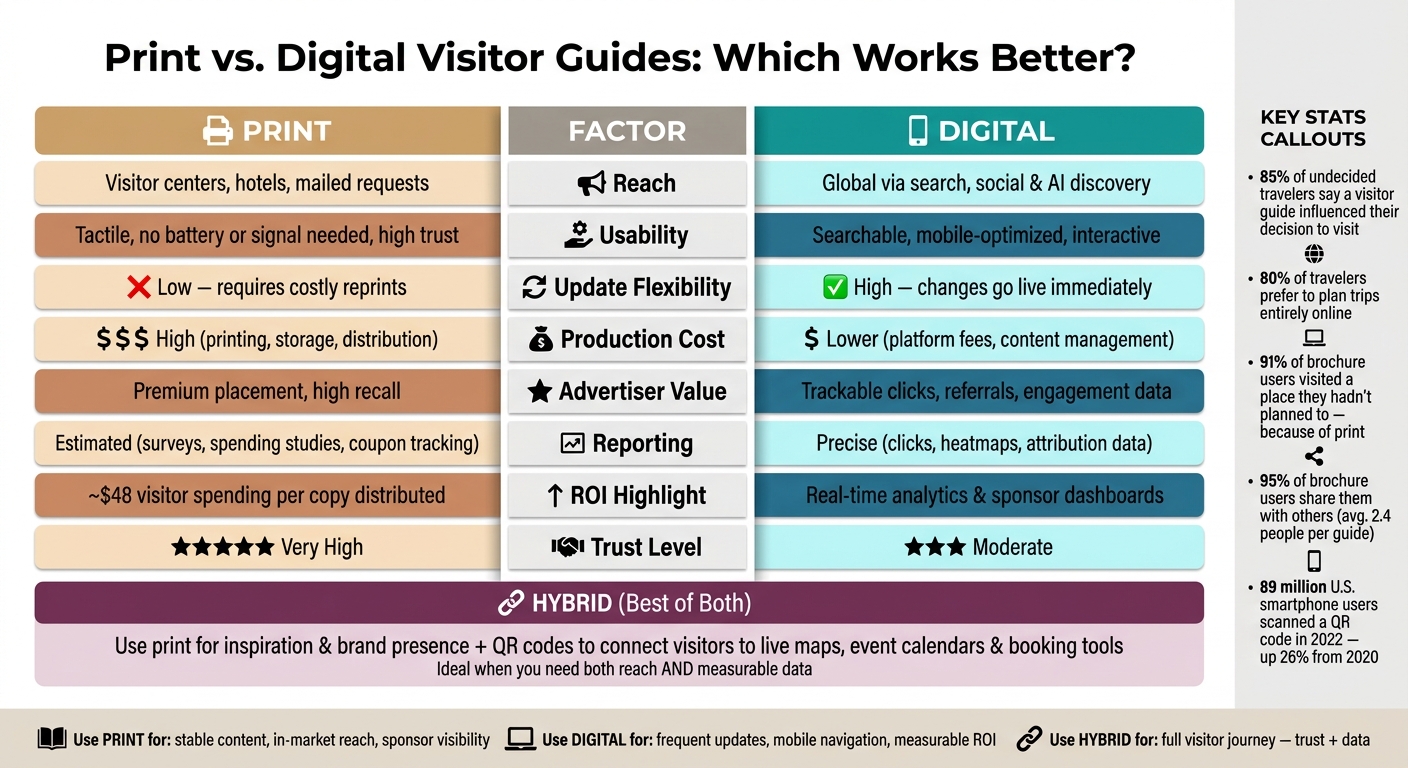
Print vs. Digital Visitor Guides: Side-by-Side Comparison
Side-by-Side Comparison: Reach, Cost, Usability, and Advertiser Value
Here’s the direct comparison.
| Factor | Digital | |
|---|---|---|
| Reach | Visitor centers, hotels, mailed requests | Global via search, social, and AI-driven discovery |
| Usability | Tactile, no battery or signal needed, high trust | Searchable, mobile-optimized, interactive |
| Update Flexibility | Low - requires costly reprints | High - changes go live immediately |
| Production Cost | High (paper, printing, storage, distribution) | Lower (platform fees, content management) |
| Advertiser Value | Premium placement, high recall | Trackable clicks, referrals, engagement data |
| Reporting | Estimated (surveys, spending studies, coupon tracking) | Precise (clicks, heatmaps, attribution, engagement data) |
The pattern is pretty clear. Print still leads on trust. Digital leads on measurement. That’s why the best format depends on what you need the guide to do.
If the goal is confidence and brand presence, print has the edge. If the goal is control, speed, and data, digital pulls ahead. And if you want both, hybrid is the smart middle ground.
When Print Wins, When Digital Wins, and When Hybrid Is the Better Choice
Print works best for out-of-market prospects, premium sponsor value, and destinations that want a physical piece visitors can keep during the trip. It also cuts down on distraction, which matters more than people think when someone is trying to plan a day out.
"A printed guide does not compete with every notification on a phone. It offers a focused, tactile way to discover a district... without distraction."
Digital wins when speed matters more than staying power. It’s the better fit for fast updates, mobile navigation, and sponsor reporting. It also does a better job reaching visitors before arrival, especially as AI-powered trip planning tools pull more often from structured website content.
For most destination programs, this isn’t an either-or call. Different trip stages need different tools. Hybrid works when you need trust and measurement at the same time. Use print for inspiration and brand presence, then send readers to live maps, event calendars, and booking tools with QR codes. That setup helps bridge the gap between pre-arrival planning and in-market use.
Conclusion: A Simple Decision Framework for Destination Organizations
Once you know which format fits the job, budget and content cadence usually make the final call.
- Use print for stable content and in-market reach.
- Use digital for frequent updates and measurable engagement.
- Use hybrid when you need both.
Some DMOs stretch print into an evergreen 2- to 3-year cycle to control costs and push time-sensitive details to the website. Destination Madison’s 2024 shift to a 100,000-copy evergreen guide, funded at roughly 10% of their total marketing budget, offers a practical model for DMOs trying to balance quality and cost.
If sponsors expect trackable clicks, heatmaps, and referrals, digital is the more efficient investment. If you need both reach and measurement, a hybrid program built around printed guides with QR codes is the most practical choice.
FAQs
How do I decide between print, digital, or both?
It comes down to your destination goals, budget, and how people plan their trips.
Print works well for inspiration and in-market discovery. It’s tangible, easy to keep around, and stays in sight longer. That can lead to spur-of-the-moment visits when someone spots an attraction, restaurant, or event and decides to check it out.
Digital is a better fit for real-time updates, lower production costs, and measuring engagement and ROI. You can change details fast, track what people click, and see what’s driving bookings or interest.
That’s why many destination marketers use both. They lean on print to spark interest, then use digital for navigation, booking, and up-to-date content.
What should go in print versus digital?
Print works best for inspiration and branding. It shines with evergreen editorial, strong photography, storytelling, and curated thematic roundups. If you want readers to move from the page to the screen, use QR codes or vanity URLs that point to live digital resources.
Digital works best for timely, update-heavy content. Think event dates, business hours, listings, and other practical details people may need right now. The smartest setup is often a hybrid one: print handles discovery, while digital delivers current details and measurable engagement.
How can I measure ROI from a hybrid guide strategy?
Measure ROI by pairing print distribution data with digital analytics.
For print, survey visitors to see what changed: more trips, longer stays, direct spending, and the overall economic impact. You can also add QR codes to printed guides so readers land on trackable pages online. That gives you a clean way to connect print with digital behavior.
For digital, watch metrics like engagement, click-through rates, downloads, ad clicks, and partner referrals. Put together, these numbers help show how the strategy shapes visitor behavior and supports local economic growth.